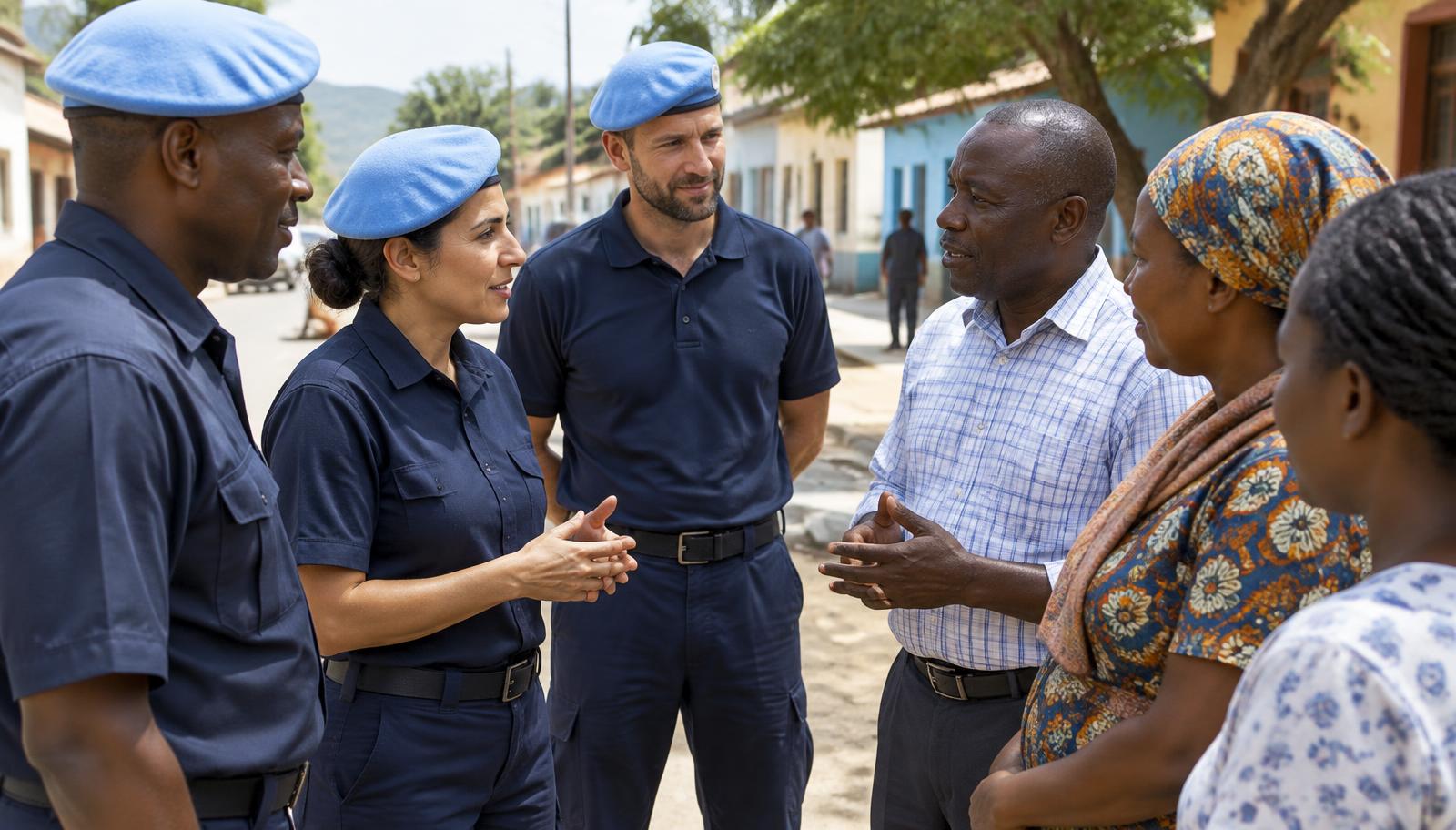
Editorial analysis, commissioned for this website with AI assistance. Recommendations are not adopted SPAG or UN policy. The cover is an existing illustrative image, not documentary evidence of a SPAG event. Sources checked on 25 October 2026.
Introduction
Policing in peace operations involves institutional relationships that differ significantly from those of a national police service. Authority may be shared, contested or limited by a mission mandate. Host-State institutions may face pressures that affect staffing, accountability, public confidence and the delivery of everyday services. International personnel must work within this environment without assuming that their familiar national arrangements can simply be reproduced. The UN Police institutional overview recognises a range of roles, including capacity support and, where mandated, substitution or partial substitution for host-State policing. This article examines the strategic challenge of matching support to those different responsibilities. Its argument is that lessons become useful when they explain context and institutional dependencies, rather than offering a supposedly universal model of success.
Understanding mandate and operating environment
A mission mandate establishes an essential boundary for international policing. The ability to advise, mentor or support an institution does not automatically include executive law-enforcement powers. Different roles require different capabilities, relationships and accountability arrangements. Participants should therefore identify the actual authorised task before assessing whether a particular approach is appropriate.
Non-mission policing assistance may operate through different agreements, national institutions and international partners. Lessons can still travel between settings, but their relevance depends on those distinctions. Comparing activities without comparing authority can produce misleading conclusions. A useful assessment asks who owns the task, who can take decisions and what resources are available, rather than treating the presence of international advisers as evidence of a uniform operating model.
Coordinating with connected institutions
Police services do not function in isolation. Their work depends on justice institutions, corrections services, administrative systems and relationships with the communities they serve. Improving one part of that system may expose constraints elsewhere. Better investigative preparation, for example, cannot by itself resolve every weakness in the subsequent handling of cases. This is a general institutional observation, not a description of a particular mission incident.
International coordination also involves actors with distinct mandates and reporting arrangements. Shared objectives are easier to pursue when responsibilities and dependencies are explicit. Regular exchange can identify incompatible assumptions, overlapping support and gaps in follow-up. It should not dissolve accountability: each institution remains responsible for its own decisions, and host-State priorities require meaningful engagement rather than merely being acknowledged in a planning document.
Matching capabilities to institutional needs
A 2016 external review, reported by UN Police, raised concerns about a supply-driven operating model and the implications of short-term deployments for capacity-building. Those findings belong to that review and should not be treated as an automatic description of every current mission. They nevertheless raise a durable analytical question: does the available support match the institutional problem being addressed?
Technical expertise, language ability, mentoring skills and organisational understanding may matter in different combinations. Numbers alone do not explain that fit. Planning should connect each proposed contribution to an identified task and the conditions needed for its use. Where a mismatch exists, describing it clearly is more useful than assuming that any additional personnel will necessarily strengthen institutional performance.
Preserving learning through personnel changes
Rotation can disrupt relationships and remove knowledge that was never documented. A handover that records only activities completed may omit why choices were made, which commitments remain open and what local counterparts consider important. Institutional memory requires enough context for a successor to judge whether earlier assumptions still apply.
Lessons learned should therefore distinguish observation, interpretation and recommendation. A training activity is an output; improved institutional practice is a different proposition requiring evidence. Records should acknowledge uncertainty and alternative explanations. Appropriate protection of sensitive information remains essential. Sharing an anonymised institutional lesson is not the same as circulating identifiable operational material, and professional interest alone does not justify unrestricted disclosure.
Practical implications for advisers and contributors
Police Advisers and contributing institutions can ask whether proposed capabilities correspond to mandate-related tasks and whether continuity arrangements support their use. They can encourage handovers that explain decisions, dependencies and unresolved questions. Where experience is discussed in a professional forum, contributors should identify the conditions that made an approach feasible and the limits of what was observed.
The UN Guidelines on Police Capacity-Building and Development provide an official reference for designing and evaluating support. Applying a learning-oriented approach does not mean prescribing identical arrangements across settings. It means making assumptions explicit, using suitable evidence and revisiting plans when conditions change. These are analytical implications, not claims that SPAG has adopted a particular mission-support policy.
Key takeaways
Mandates and authority must be understood before comparing policing approaches.
Institutional development depends on connected justice and governance arrangements.
Capability fit matters more than an undifferentiated account of personnel numbers.
Lessons should preserve context, uncertainty and the reasoning behind decisions.
Conclusion
The central challenge of international policing support is not simply transferring expertise, but ensuring that expertise is relevant, authorised and sustainable. Context-sensitive coordination and careful institutional learning can help contributors assess what support is useful. They also provide a more credible basis for professional dialogue than generalised claims about mission success or failure.
Sources and further reading
UN policing — United Nations Police; undated institutional overview
Guidelines on Police Capacity-Building and Development — UN DPKO/DFS; effective 1 April 2015