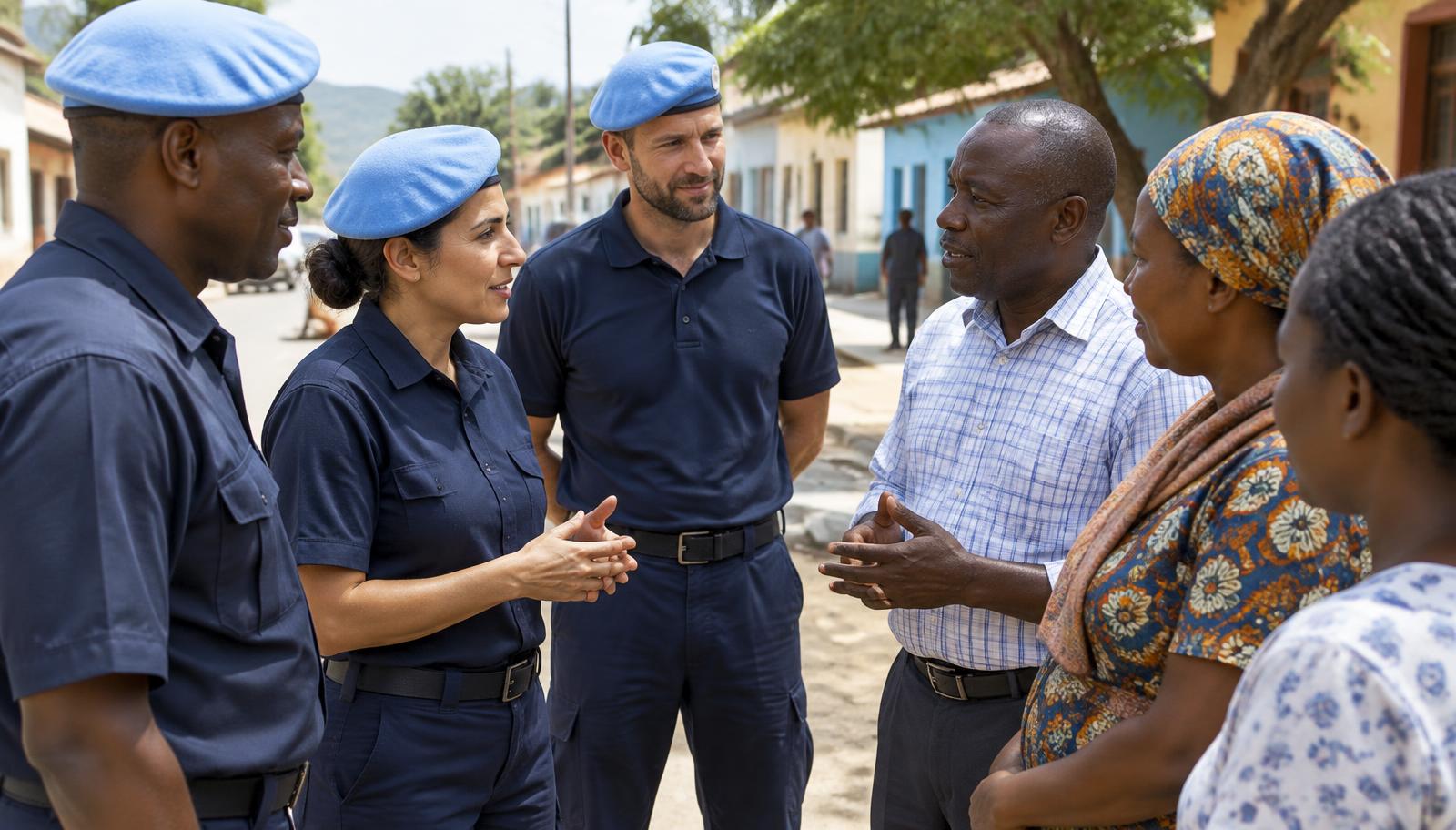
Editorial analysis, commissioned for this website with AI assistance. Recommendations are not adopted SPAG or UN policy. The cover is an existing illustrative image, not documentary evidence of a SPAG event. Sources checked on 25 October 2026.
Introduction
Preparing police personnel for international deployment requires more than confirming that they are experienced professionals. International assignments can involve unfamiliar institutional relationships, different legal contexts and responsibilities that do not mirror a person’s national role. Recruitment, selection and training should therefore be considered as connected parts of capability development, while respecting the official processes that govern actual appointments. The UN Police information page explains that most officers are seconded or loaned by their governments and that the Division works with Permanent Missions to identify suitable skills for mission mandates. This article uses that institutional context without creating eligibility rules. Its argument is that preparation becomes more effective when contributors examine the fit between experience, authorised tasks and the support needed throughout deployment.
Connecting qualifications with relevant experience
Professional qualifications provide important information, but their relevance depends on the role under consideration. Experience in one organisational environment does not automatically establish readiness for every international policing task. Contributors need to consider the function to be performed and how a person’s knowledge can be applied within the applicable mandate and institutional arrangements.
This is an analytical point rather than a selection criterion. Current requirements should be checked through official UN information and the relevant national and UN channels. Advisers should not turn a discussion about desirable expertise into a claim that a particular qualification is mandatory. Clear separation between general preparation and formal requirements helps protect candidates from inaccurate expectations and preserves the authority of those responsible for personnel processes.
Understanding readiness as more than technical skill
Readiness includes understanding the responsibilities, relationships and constraints of an assignment. Personnel may need to work across languages, institutions and professional traditions while interpreting guidance that differs from national practice. Familiarity with one’s own police service is valuable, but it does not remove the need to understand the environment in which that expertise will be used.
Support arrangements matter too. Preparation should consider how personnel obtain clarification, maintain professional standards and access appropriate institutional support. A deployment should not be treated as a self-contained transfer of individual expertise. The ability to use specialist knowledge depends on the surrounding organisation, available resources and the clarity of the task. These dependencies deserve attention alongside personal experience and confidence.
Distinguishing individual, specialist and unit capabilities
Individual police officers, specialist roles and Formed Police Units contribute different capabilities. Their preparation should reflect their authorised functions rather than an assumption that a single training approach will meet every need. Institutional discussion is more useful when it describes the purpose of a capability and the support required for its application, instead of relying only on labels.
Coordination also involves the way different contributions relate to one another. Leadership, professional standards and communication may affect whether capabilities can be used coherently. This article does not describe operational deployment methods or prescribe a unit configuration. It emphasises the strategic need to understand distinctions and dependencies when Member States and relevant UN entities discuss preparation, support and capacity-building priorities.
Linking training with continuing professional learning
The UN Police Training Architecture Programme provides an official example of cooperation to update pre-deployment training in line with the Strategic Guidance Framework. Its description includes specialised and job-specific curriculum development. This supports a distinction between broad orientation and preparation for particular responsibilities, without implying that every published programme description is a complete account of current requirements.
Training is most useful when participants can connect learning with the tasks they may perform. Assessment should consider understanding, and professional development should remain open to gaps identified later. Supervisors and institutions also influence whether learning is applied. Attendance alone is therefore an incomplete measure of preparedness, just as a completed course does not by itself demonstrate sustained organisational performance.
Practical implications for Member States and advisers
Contributing institutions can review whether their preparation explains mandate context, professional standards and the relationship between national experience and international responsibilities. They can identify questions requiring official clarification and avoid relying on informal interpretations of recruitment information. Maintaining current references is especially important where published procedures or role requirements may change.
Police Advisers can support this work through professional dialogue about recurring preparation needs and specialist expertise. The supplied SPAG website brief includes recruitment-related discussion and capacity-building for individual officers, FPUs and specialist roles. Connecting those themes does not establish new selection authority. Recommendations should identify their evidential basis and remain distinct from formal UN requirements and from any collective position not explicitly authorised by SPAG.
Key takeaways
Relevant experience must be interpreted in relation to the intended responsibility.
Current eligibility and selection requirements belong to official processes.
Individual, specialist and unit capabilities require appropriately differentiated preparation.
Training should connect to continuing learning and institutional support.
Conclusion
Effective preparation links professional experience with the context and responsibilities of international service. Recruitment, selection and training are connected, but they have distinct purposes and authorities. Strategic dialogue can improve the quality of questions and the understanding of capability needs without inventing procedures or promising that a particular qualification, course or nomination guarantees deployment.
Sources and further reading
Information for Candidates — United Nations Police; undated guidance page
UN Police Training Architecture Programme — United Nations Police; undated programme overview
Strategic Guidance Framework — United Nations Police; undated overview